
Why is it always raining?
Is this going to happen every winter?

Britain has a gentle climate. You have to be very incompetent or very unlucky indeed to lose your life in the UK due to adverse weather conditions. Extremes of hot and cold hasten the demise of some elderly people but generally speaking we are all going to survive all those continuous yellow, amber and red weather warnings. Our train or flight may get cancelled, a road may get closed or if we are exceptionally unlucky a tree may fall on us. But that’s probably it.
Around five or six people die each year when trees or branches fall on them. That’s about a 1 in 10 million chance you are going to die like that this year. It’s not a lot but its a higher risk than cows (4 to 5 a year), terrorism (about 4 a year on average this century) and lightning (about 3 a year). You are about 100 times more likely to die in a road accident than from any of these causes.
But there’s one major exception - flooding. The Great North Sea flood of 1953 killed 2,000 people, 307 of them in the UK. Flood defences were significantly reinforced after that and there have been very few flood fatalities since then, although 13 died in the 2007 summer floods. But sudden extreme rainfall can have unpredictable and tragic consequences, as we saw in Valencia in 2024 - a flash flood in a localised area of the city caused 230 deaths.
Here in Hampshire in the UK we had the wettest January since 1877, and the second wettest since records began in 1836. Here’s a picture of Havant flooded in 1877 - it’s not exactly Waterworld, but maybe the exposure time was so long in those days that the water level had dropped by six feet in the time it took to take the picture.
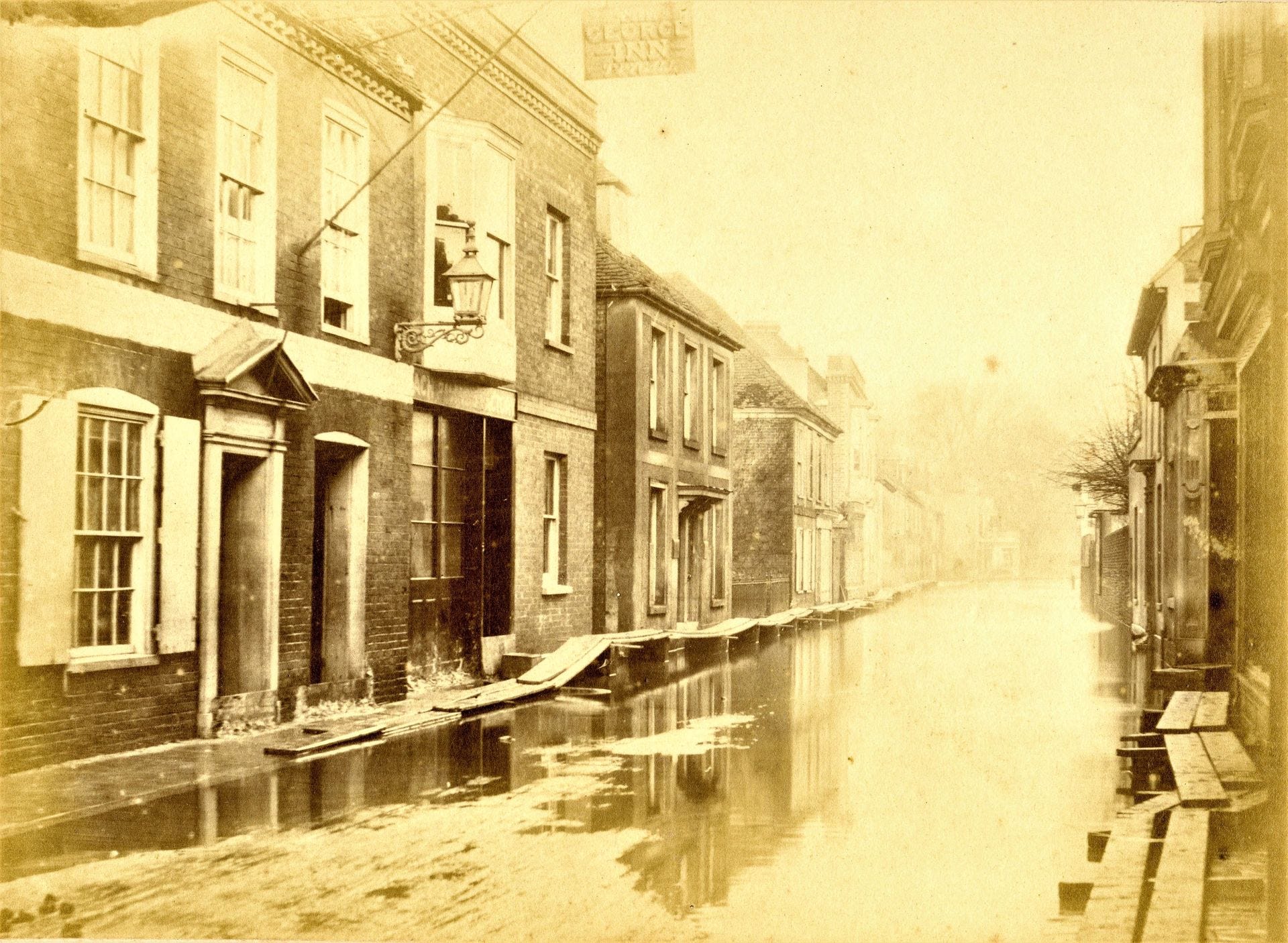
The current wet weather is no more than an inconvenience for most of us, although it is also an emblem of Britain’s current torpor and incipient immiseration. Bill Bryson said that winter in Britain was like living in Tupperware. This is like living in a sieve in a 24 hour dark kitchen. For others of course it is more serious, affecting their livelihoods. Many winter crops, like wheat and barley, have been submerged too long and have rotted and died, and others like cauliflower and kale will become diseased.
But for most of us it’s just another chance to grumble about something and the biggest risk is automotive - tyre, wheel and suspension damage on roads that are now more pothole than tarmac, crashing while looking at a driving app to avoid the biggest potholes, or losing a vehicles versus water battle - check out this strangely compelling Youtube channel.
So finally I get to the point of this bleat. Is this climate change? Do we need to get used to this every year? Is it somehow Keir Starmer’s fault like everything else? His personal ultra-low pressure micro-climate gradually enveloping the entire territory he is attempting to govern? Or is it, just, you know, weather?
There are two proximate causes of the persistent wet weather. The jet stream is unusually strong and further south than usual, and it’s acting like a conveyor belt constantly funnelling low pressure systems towards north west Europe (where Britain still is, despite Brexiteer hopes for us to relocate to a more “global” position off the American coast (shoe-horned Brexit reference, tick)). And second, there is a “blocking” high pressure area over Scandinavia which is stopping our low pressure areas moving away after they have rained on us, and they are hanging around and “raining out” as the BBC weatherwoman described it nicely the other day. Though the word “out” does suggest they stop at some point which we have not yet experienced.
The Goat’s readership is made up exclusively of intelligent and thoughtful individuals who I know will not be satisfied with that glib explanation. Why is the jet stream so far south and so strong? Why is that high pressure area stuck over Scandinavia?
The jet stream is a fast-flowing ribbon of air about six miles above the Earth’s surface and which can reach speeds of 200 miles an hour. It has a big effect on weather systems below it. The temperature contrast between cold polar air above it (latitudinally speaking) and warmer air below creates the high-altitude wind. The greater the contrast the stronger the jet stream, and the stronger the jet stream the more low pressure systems we get.
The Arctic is warming faster than anywhere else, nearly four times faster. So the contrast between cold Arctic air and warmer southern air should be less and therefore the jet stream should in principle be weaker, leading to more areas of high pressure and less rainfall.
As MIT’s climate portal explains, a slower jet stream is more likely to bend north and south as it encounters small variations in temperature and pressure. If it bends a lot it can cause unusually warm temperatures in parts of the Arctic at the same time extreme cold spells reach far south. “In February 2021, for instance, Texas endured over a week of freezing temperatures the state was not prepared for, causing power outages and killing hundreds, while much of northern Eurasia also saw extreme cold. And because a weak jet stream moves slowly, these weather conditions can last for days at a stretch”.
But there’s something else up there, even higher up, affecting things. The Polar Vortex hangs around the North Pole around 30 miles above the Earth’s surface and meteorologists have come up with the rather lame sub-Game of Thrones for it, the “keeper of cold”, as it locks the cold air into the Arctic region. But it’s weakened recently due to a Stratospheric Warming event (an SSW) due to a rise in pressure and temperature in the stratosphere. That’s allowed cold air to move south, making North America intensely cold and pushing the jet stream south and making it stronger. It also means that cold air intrusions south of the arctic circle into say Scandinavia can create blocking patterns, as has happened this year. So there’s our culprit.
Are we going to see more SSWs with climate change? In summary, it’s complicated. Basically, scientists are not sure whether SSWs are going to increase with global warming or not.
What they are much surer about is that the warming arctic, compounded by melting sea ice which means less reflectivity and further warming, will lead to a weaker, wavier jet stream, with greater potential to lodge weather patterns in place for longer periods of time. We will get lingering heatwaves or cold snaps reaching deeper toward the equator, floods from incessant downpours, and wildfires across the northern hemisphere.
So we might get more of this sort of weather in the future as a result of a weaker jet stream unable to shift areas of high pressure to the north or south of us, and if we are unlucky we get persistent low pressure systems for weeks on end. But right now we have a powerful jet stream due to the unstable polar vortex and that’s landed us with a similar result.
So in answer to my question “is this going to happen every winter?” the answer seems to be “no, but it will probably happen more often than before”. And generally warmer temperatures mean our atmosphere can hold more moisture and therefore more rain occurs - six of the ten wettest winters ever have been this century. And the rise in sea levels makes flooding more likely.
I wanted to mention something that may drastically affect our future weather while I am on the subject. You know about the gulf stream - it’s not the same as the jet stream - the jet stream’s in the air and the gulf stream is in the water. It’s a powerful warm Atlantic Ocean current that originates in the Gulf of Mexico (or Gulf of America as the American government has pathetically and insecurely renamed it), flows along the U.S. East Coast, and crosses to Europe. It brings warmer, wetter weather to western Europe. But it’s not the cause of our current rainathon.
So why mention it? Well, it’s part of the AMOC - that’s the Atlantic Meridional Overturning Circulation - a climate system that transports warm water from the tropics towards the North Atlantic, where it cools, sinks, and returns south. It regulates global temperatures. There’s a fear it will run amoc collapse some time this century as a result of climate change, which would cause much more extreme weather for Europe. Average winter temperatures in the UK could drop by up to 10°C, making conditions feel like Northern Norway. We would experience more intense winter storms while summers could become hotter and drier. Reduced rainfall and extreme temperatures would be catastrophic for food production. At last we would have some proper weather, and a lot more deaths from flooding, snowstorms, extreme temperatures and possibly starvation as crops failed.
In years to come we may grow quite nostalgic for our current soggy, dull, mild, safe but slightly irritating climate. If politicians were climates, we’d be swapping Keir Starmer for Putin. But luckily all countries on Earth, with one notable large idiotic exception, are finally embracing clean energy and emissions are starting to drop, even in China. It may be too little too late, but here’s hoping we stay soggy.
Complicated, as you so rightly (and so clearly and concisely) say. We've never quite known what the weather will bring in this country, and I guess that looks set to continue! It makes for a good talking point, when out for a walk with the dog or standing in the supermarket or bus queue ...
I think there might be 3, rather large ones!
A fscinating account. Flooding in Hampshire in the 1880s? I believe the Thames used to freeze completely over between the 17-18C with a "frost fair" on it in 1814! Global warming since? But then there was 1963 - what happened then? It is..as you say, complicated - but our weather in the UK is definitely changing - maybe the Bible's will eventually be right? But who will be in the Ark? I dread to think!!